|

|
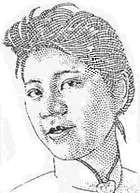
| Vivian Yang a la Wall Street Journal |
|
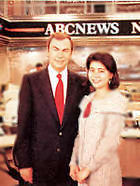
| As a journalist with Sam Donaldson in ABC New York |
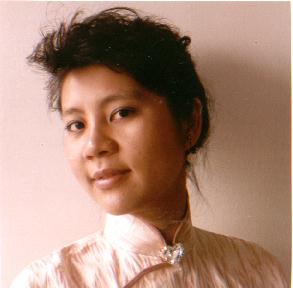
"I would have been criticized as the 'puppy bitch of the imperialists' lackeys' and punished."
In a 2002 ASIAN WALL STREET JOURNAL
article, Vivian Yang ponders the meaning of being a bilingual Asian-American writer from China:
Born in Shanghai in the 1960s, I often wish that I had been exposed to the English language and Western culture in
my childhood. My university professor parents were denounced as the "Stinky Number Nines," a class designation that ranked
them ninth on the list of "class enemies." When I was in primary school, they were sent to separate farms to "receive re-education
from the poor and lower-middle peasants."
The Red Guards had confiscated most of the English language books in my parents' extensive library, many of which
were leather bound with golden imprints. They left behind little more than the bilingual "Quotations From Chairman Mao Tse-Tung,"
the "Little Red Book." To protect me, my parents allowed no English in the household for fear that I would speak it outside,
where I would have been criticized as the "puppy bitch of the imperialists' lackeys" and punished.
In school, the Chinese language teacher urged us to keep a "red (meaning revolutionary) diary." Instead, I kept two
sets of notes, one for the teacher to review, the other for secretly composing short stories and essays regarded at the time
as "the bourgeois poisonous weeds."

|
| On Channel NewsAsia |
As an author, cultural commentator, interpreter, journalist, on-stage bilingual MC, public speaker, and university
lecturer, Vivian's feature stories, fiction, media appearances, op-ed contributions, radio/TV broadcasts, and books
reviews have been featured in The APA Journal, The Asian Wall Street Journal, BBC World Service,
Business Weekly, Channel NewsAsia, China Daily, CCTV-International, Dimsum, Far
Eastern Economic Review, HK Magazine, The National Law Journal (U.S.), The
New York Times, PBS affiliate KUAT-TV, Radio Beijing, The Sampan, South
China Morning Post, The Voice of America, among others.
|
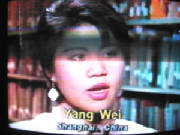
| On PBS affiliate KUAT-TV |
Read Vivian's review of Gay Talese's "A Writer's Life" (2006) for the South China Morning Post
Merging East & West on paper
My brain switches gears when I transition from recalling my over three decades' of life's experiences
in greater China to fictionalizing them in English. Writing in a foreign language having no linguistic or cultural connections
to my own is like building a cross-cultural bridge -- one English alphabet or Chinese character stroke at a time.
|